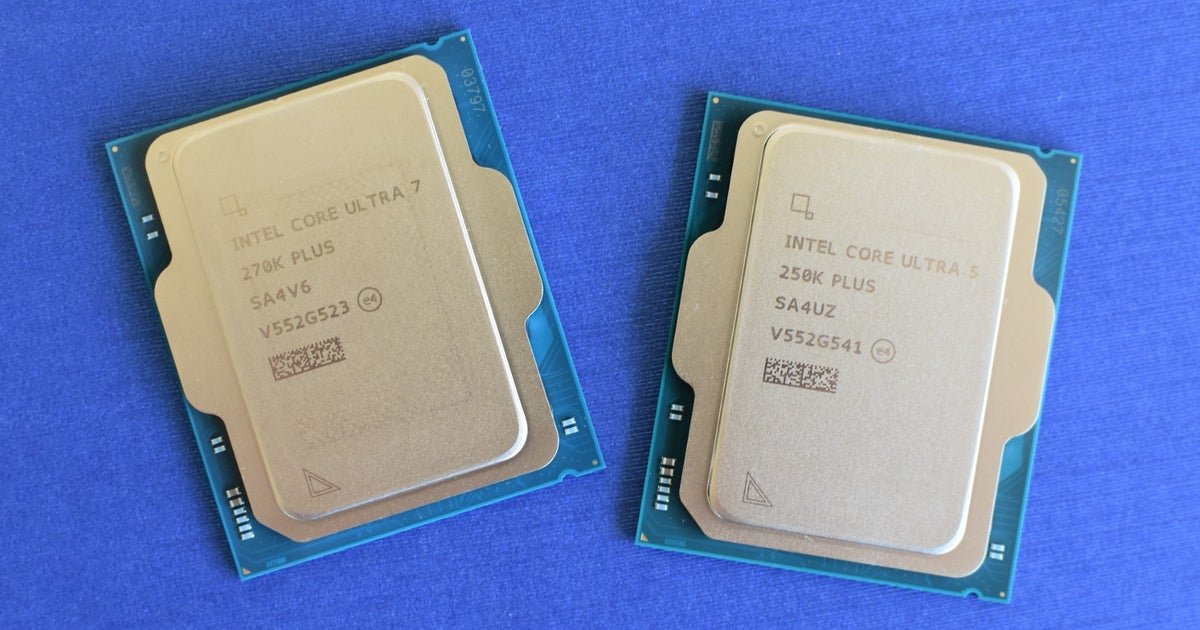

Whether or not Intel says it out loud or not, the Core Extremely 7 270K Plus and Core Extremely 5 250K Plus each characterize an try and proper the wrongs of the unique Arrow Lake/Core Extremely 200S household. This bundle of chips was essentially extra energy environment friendly and ran cooler than the short-tempered 14th era mannequin that preceded it, however at the price of slower gaming efficiency. Such fascinating qualities are not often seen in gaming CPUs.
These two Core Extremely 200S Plus (or Arrow Lake Refresh) processors provide some traction as compared. These are low-cost, nice multitaskers, and whereas the silicon mind continues to be environment friendly, Intel is attempting to spice up gaming speeds by re-tuning the internals to a much less latency-prone structure.
Oh, that is not sufficient. The Core Extremely 7 270K Plus and Core Extremely 5 250K Plus not solely have slower gaming speeds than AMD’s greatest chips, however additionally they fail to convincingly beat Intel’s again catalogue, which incorporates 2023-vintage 14th era processors.
That is particularly unlucky as a result of the corrective actions Intel has taken with these chips are, on their face, smart. It might be identified that there isn’t a vital clock pace enhance. The 270K Plus’s max enhance clock of 5.5GHz stays the identical because the Core Extremely 7 265K, and the 250K Plus solely bumps as much as 5.3GHz from the Core Extremely 5 245K’s 5.2GHz. However whereas earlier generations of Intel Core have elevated clock speeds over time, they’ve had little impact past the more and more problematic temperatures.
As an alternative, the Core 200S Plus Duo delivers a 900MHz pace enhance to die-to-die (D2D) frequencies, particularly addressing points with the unique Core 200S mannequin the place the as soon as built-in reminiscence and compute controller was break up into completely different tiles and distributed throughout the processor. Though that is extra energy environment friendly, it introduces latency as a result of disparate parts require additional time to speak with one another. Growing the D2D frequency ought to pace up this course of and produce gaming efficiency again to what it was when Intel chips have been nonetheless monolithic.
These CPUs are additionally the primary to make use of Intel’s Binary Optimization Software (sorry Brits, that is what it says right here). A brand new part of the Intel Software Optimization (gargh) app, this device is meant to hurry up sure video games designed with older processors in thoughts. Or quite, the Core Extremely 7 270K Plus and Intel Core Extremely 5 250K Plus will likely be sooner and extra game-specific directions per clock (IPC). This primarily implies that the chip can do extra processing on every CPU clock cycle, rising efficiency with out having to extend the clock pace (and subsequently temperature) itself. That is sensible on paper.
By way of testing all of those, maybe barely I wasn’t actually within the authentic Arrow Lake chips, so I by no means recorded any correct benchmark outcomes. However I nonetheless suppose it is sensible to carry off on these new components till the 14th era as a result of requisite bar chart competitors. Each of those components are nonetheless doubtless topics of “ought to I improve?” That includes essentially the most dependable and high-performance Intel chips in years. We additionally launched the AMD Ryzen 7 9800X3D. If Intel is severe about making the Core Extremely 7 270K Plus its “quickest ever” gaming CPU, it should not thoughts comparisons to high performers within the Ryzen camp.
So keep watch over gaming benchmarks.
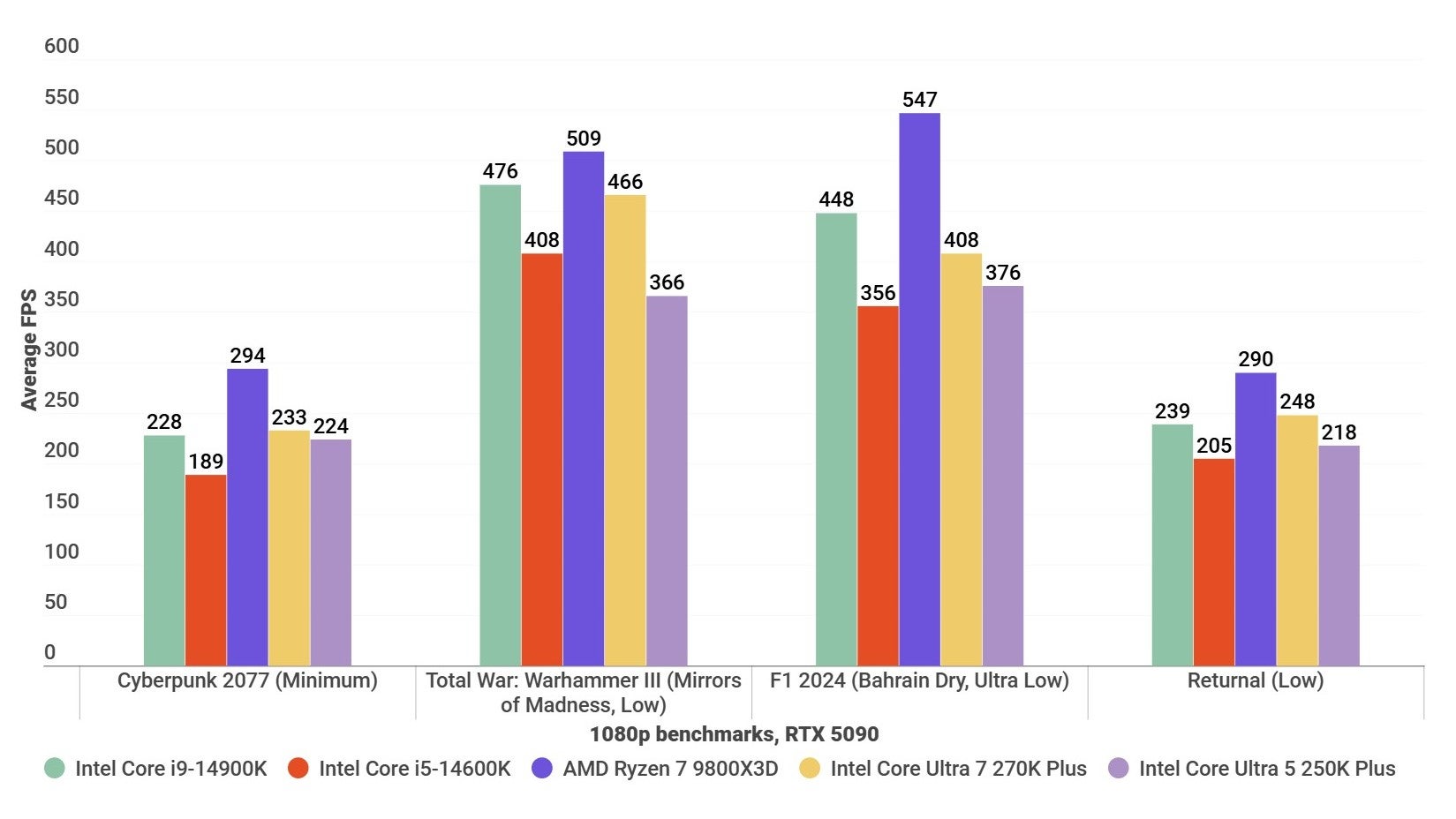
From an Arrow Lake Refresh perspective, that is clearly not learn. The 2 new chips could also be an enchancment, however solely within the sense that they are about as quick because the 14th era, not that they are repeatedly worse. And it nonetheless lags behind in Whole Battle: Warhammer III, the place the Core Extremely 5 250K Plus cannot even match the Core i5-14600K from years in the past.
The one actual win right here is Cyberpunk 2077, the place the 250K Plus really outperforms its ancestor by a big margin, and the 270K Plus barely outperforms the previous flagship Core i9-14900K. Unsurprisingly, that feat was replicated in Returnal and almost completed in Warhammer III. Observe that the “quickest ever” declare comes with a giant daring asterisk, contemplating the brand new CPU can be 10% slower in F1 2024. Additionally, that is clearly removed from the extent of Ryzen 7 9800X3D.
We discovered that the usefulness of binary optimization can be restricted. A part of that’s as a result of device not supporting a variety of video games (barely over 12 on the time of launch). Nevertheless, even when it really works, it is not a magical speed-up button. In Cyberpunk 2077, 270K Plus was tweaked from 233fps to 243fps by enabling this device. That is solely a 4% enchancment in a recreation that was already extra forgiving of Arrow Lake Refresh than most video games. 250K Plus additionally goes from 224fps to 233fps, one other slight 4% enhance, however this no less than reveals that binary optimization can convey Core Extremely 5 {hardware} efficiency as much as no less than Core Extremely 7 requirements when you’re involved in midrange. In sure video games. and circumstances. I will additionally assume you do not simply allow the identical instruments in Extremely 7.

Nonetheless, I do not really feel as unhealthy about Arrow Lake Refresh as I do about Intel’s earlier misfires. Taking that into consideration, it is an clearly overzealous try and make up for the sport’s efficiency, even when it in the end fails. Extra virtually talking, this CPU duo has rather more to supply.
Multitasking and productiveness are two issues. While you do issues in your PC that may take higher benefit of multi-threading than gaming, like modifying or encoding or stay streaming when you’re into that type of factor, each the Core Extremely 270K Plus and Core Extremely 250K Plus deal with the workload rather more deftly than their older alternate options. Even when the 270K Plus is not outright Intel’s quickest gaming CPU, it is fairly attainable that it is the highest-scoring mainstream CPU in Cinebench’s simulated benchmark checks, and the 250K Plus ended up beating the Core i5-14600K right here as effectively.
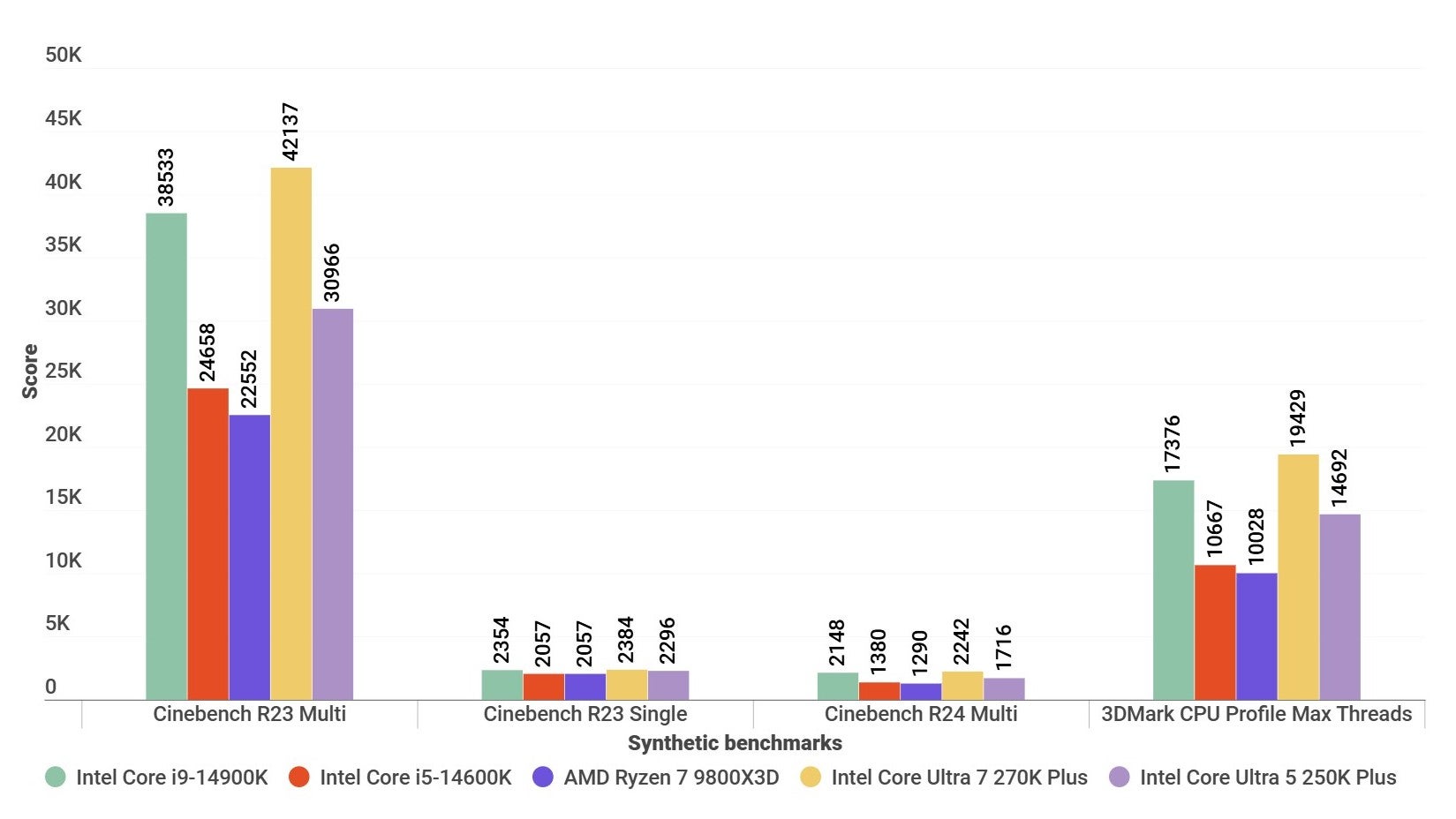
Once more, there are not any outcomes for the unique 200S equal, however the sensible cash continues to be on the brand new CPU. Each have 4 extra E cores (E for effectivity) than their pre-refresh counterparts. Whereas these aren’t as massive and rugged because the included P cores (P for efficiency), they nonetheless add 4 extra threads for the CPU to work with, with minimal additional pressure on energy or warmth.
Talking of which, each chips stayed effectively cooled within the budget-friendly Thermalright Peerless Murderer 120 SE air cooler I examined. On the identical setup, the Core i9-14900K’s P-core peak temperatures reached 90°c whereas gaming and even reached the 100°c hazard zone whereas working Cinebench, whereas the Core Extremely 7 270K Plus solely rose as much as 76°c throughout play and remained at a secure 90°c throughout the benchmark’s peak. The Core Extremely 250K Plus was even colder, with peak temperatures of 68°c when gaming (down from 77°c on the Core i5-14600K) and 74°c on the cinebench (down from 82°c). Other than the Ryzen 7 9800X3D’s peak temperature of 88°C in Cinebench, each chips have been persistently cooler than AMD’s biggie.
The truth that these processors can run on low-cost coolers is particularly welcome at a time when reminiscence shortages are driving up part costs and, in flip, painfully excessive prices to construct new PCs. And to not point out how bullish the costs are for these CPUs themselves. At $300 for the 270K Plus and $200 for the 250K Plus, they’re about $100 cheaper on common than comparable Arrow Lake merchandise, and the previous particularly is almost $200 cheaper than the Ryzen 7 9800X3D. This alone pays for a correctly specced motherboard (if not a adequate set of RAM, sadly).

That is anticipated to be the final era of Intel CPUs to suit into the LGA 1851 socket, so new motherboards will not be capable to carry future chip upgrades. Nevertheless, the CPU is just not the kind of part you exchange ceaselessly.
The Core Extremely 7 270K Plus and Core Extremely 5 250K Plus function inexpensive multi-threaded engines. It is also reassuring that Intel really is aware of the temperature. 14900K particularly was all too prepared to succeed in boiling level.
But it surely’s nonetheless much less preferable than a shiny new Ryzen, and even an improve from a not-so-old Intel platform, particularly for gaming. At this level, we do not see any worthwhile enhancements to the present 14th Gen Core, or maybe the equal of the thirteenth Gen Core. In the meantime, AMD’s 3D V-cache expertise nonetheless eclipses Intel amongst fanatics.
In that regard, the wisest buying determination could also be to easily wait. Intel is about to launch one more CPU household, Nova Lake, later this yr, and there is speak that they’ve their very own reply to 3D V-Cache within the type of BLLC (Huge Final-Stage Cache). Throwing an enormous reminiscence retailer at a recreation’s framerate might not sound as elegant as one thing like D2D optimization, however hey, that is what’s labored for AMD for years. And clearly, it is time for Intel, no less than for itself, to attempt one thing completely different.